1: Introduction | 2: India | 3: China | 4: Egypt | 5: Myths, legends | 6: Cultural syncretism
Part 7: Epilogue
At this point of the investigations on the origin of chess there are
things we know, things we suppose we know and things that we ignore.
Let’s list them one by one:
We know that the game arose in the Orient.
We know that there are only three theories that
present valid sources to support their stance on the original source of
the game: the one that locates the origin in India; the one that focuses
on China, and that of cultural syncretism.
We know that a variant of proto-chess entered Persia in the sixth century AD coming from a region of India.
We suppose that this game was chaturanga, in its two-player modality, which was taken to present-day Baghdad, the capital of the Persian Empire.
We know that the first precise mentions to a variant
of proto-chess, coming from diverse literary sources, appear in the
fourth century AD, the first of which refers to the Chinese xiang-qi and the second one to chaturanga.
We know that both xiang-qi and chaturanga had their respective transformation processes.
We know that there are two previous games that were
born in these cultures, which had been recorded in literary works since
ancient times: the Chinese liubo and the Indian ashtāpada.
We suppose that xiang-qi — if it came exclusively from the Chinese culture — could have been conceived from liubo.
We suppose that chaturanga — if it came exclusively from the Indian culture — could have been conceived from ashtāpada or chaturaji.
We ignore the sequence in which chaturaji and chaturanga came to be (although the predominant theory is that the latter came first), or even if chaturaji is a mere position of chaturanga.
We know that a version of xiang-qi has survived to the present day (it is currently played in China and, at least, also in Vietnam) while chaturanga disappeared as a practice at some distant moment in time.
We ignore under which precise circumstances chaturanga abandoned the use of dice.
We ignore whether the evolutionary process of chaturanga went from the four-player version to the two-player one or the other way around.
We suppose that a synthesis of several previous
games was generated on the Silk Route, appearing a new prototype
that later turned into chess.
We ignore if, at the end of that process, only one game arose or, if on the contrary, both chaturanga and xiang-qi appeared simultaneously.
We suppose that the games that were part of the process of cultural syncretism were liubo, ashtāpada and the Greek petteia, and possibly the process took place under the influence of an old astrolabe of Babylonian origin.
We suppose that this symbiosis occurred in a period of time between the second century BC and the third century AD.
We suppose that the process took place in a vast region occupied successively by the Kingdom of Bactria and the Kushán Empire
We know that the oldest archaeological findings of
pieces that were used in some variant of proto-chess — which correlate
perfectly with the geographical zones linked to the Silk Route — existed
approximately in the sixth century AD.
We suppose that in the future other important
archaeological elements will be discovered that, depending on
their location, characteristics and antiquity, will strengthen our
knowledge regarding this matter.
We know that it is necessary to deepen the analysis
with regard to the theory of games, establishing greater precision and
causal relationships between the various variants of proto-chess and
linked practices — namely ashtāpada, chaturanga, chaturaji, liubo, xiang-qi, petteia and others.
We know that there is much yet to be investigated on the origin of chess.
We suppose that we will eventually find an
answer that, without becoming an absolute certainty, at least will
allow us to find a major consensus, thus establishing a uniform
explanatory paradigm on the origin of chess.
Master Class Vol.9: Paul Morphy

Learn
about one of the greatest geniuses in the history of chess! Paul
Morphy's career (1837-1884) lasted only a few years and yet he managed
to defeat the best chess players of his time.
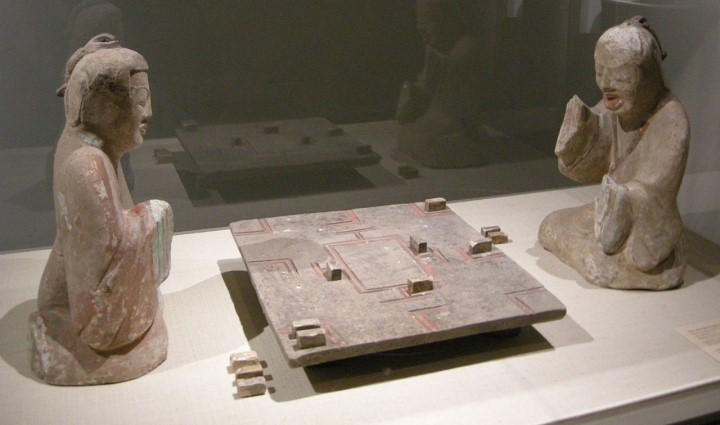
Statuettes probably from the first to the
second century of the Christian era representing two players disputing a
game of liubo. | Photo: Wikimedia Commons
Epilogue
Chess might be the product of a cooperative process — and we would
prefer it to be this way, to show that Humanity has the capacity to
be virtuous at times (although it is known that it usually favours
quarrels, often bloody, between people who seem to forget that they come
from a common origin). The game could also have been an
invention/creation/discovery of a single culture. Anyway, there is only
one thing that is entirely certain: as Borges correctly pointed out,
chess comes from the East.
In that sense, we have presented the different protohistoric versions
regarding the origins of the game, focusing on that geographical space
(India, China, Persia and other undetermined spots within the Silk
Road), with physical or literary records that refer to a few centuries
before and after the arrival of Christ.
There are quite exact records of many specific episodes, such as the
time when one of the versions of the game entered Ctesifonte from India,
which happened exactly in the sixth century AD. From that moment on,
everything is quite clear, in terms of the diffusion of chess; before
this event, however, everything is much less clear.
In this context of uncertainty, there are conflicting theses on the
origin of chess, some of which have empirical support while others can
only be recognized as myths or legends. All of them, with the inevitable
omissions born out of the vastness of the analytical field, were
compiled in this work.
After all, there are mainly three possibilities with a high degree of
truthfulness and verisimilitude: two of them correspond to particular
cultures — those that consider that chess comes from the Indian chaturanga or the Chinese xiang-qi;
the third possibility, on the other hand, recognizes the existence of a
syncretic civilizing effort, postulating a confluence of practices from
different civilizations.
Beyond the validity of this trio of hypotheses, which are often each
seen as independent efforts, we believe that an effort can be made to
integrate the perspectives.
All the theories present elements that can be interconnected, in
their complementarity, leaving aside, or perhaps reinterpreting, the
divergences between them. The fact that the different variants of
proto-chess have emerged in a wide but interconnected geographical
space, and that this has happened in temporal synchrony, gives strong
clues to a fact that we believe is incontrovertible: we are in the
presence of a single family of games, with interconnected processes of
evolution, which have yet to be fully discerned.
By extending the analysis, it would be possible to trace not only the
interrelationship of the various proto-chess variants but also their
origins in even older games. We could even go back to the Egyptian senet and, reconstructing the sequence from there on, arrive at chess as it was redefined in medieval Europe.
Under these conditions, it would be possible to work no longer from
univocal, fragmented perspectives, but rather by proposing a holistic
theory, integrating the evidence of each singular hypothesis, in such a
way as to construct a unique, all-encompassing explanation.
Thus, instead of giving pre-eminence to chaturanga or xiang-qi
an initial prototypes, it could be believed that at least one game
appeared on the Silk Road from which these were derived, either
concomitantly or sequentially. Therefore, in that case, the former would
not derive from ashtāpada and the latter from liubo — rather, these earlier games, probably together with the Greek petteia and with
the contribution of an ancient Babylonian astrolabe, produced a variant
of proto-chess via cultural syncretism. This game, from then on, would
expand through different routes, to the East and to the West.
So there are very interesting lines of exploration still to be
developed. Although the possibility of testimonials appearing from
ancient manuscripts on the subject is increasingly remote (although not
entirely impossible), there could appear new archaeological findings
that provide new clues, particularly in regard to the dating of games’
vestiges, which could better establish interrelationships and sequential
information about these practices.
It is also possible, and indeed necessary, to continue to deepen
structural analyses, based on the intrinsic characteristics and
aetiology of the various games, in order to determine more precisely
their correlation according to historical, geographical and cultural
variables. This question is central to the design of the common
evolutionary tree discussed above.
In any case, it is necessary to deepen the understanding of the practices that would have served as inputs of the proto-chess — petteia, liubo, ashtāpada
— so that it will be possible to evaluate with more certainty, from the
study of their particularities, the degree in which they could have had
an effect in the subsequent modalities: xiang-qi and chaturanga.
Master Class Vol.4: José Raúl Capablanca

He
was a child prodigy and he is surrounded by legends. In his best times
he was considered to be unbeatable and by many he was reckoned to be the
greatest chess talent of all time: Jose Raul Capablanca, born 1888 in
Havana.
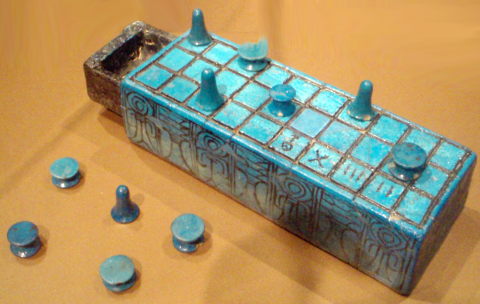
A ‘senet’ board that may correspond to the 14th century B.C.
In short, where did chess originate and under what circumstances?
We could simply reproduce some well-known legendary stories, such as
the ones that attribute the invention of the game to Sissa the Wise or
the queen of Lanka — or even to the battle in which a sovereign lost one
of her sons in confrontation with his brother.
We could focus on divinities, on the esoteric world or on fictional literature.
We could, without analysing the whole, but observing only the parts,
attribute the creation of the game to Indians, Chinese or other culture.
We could say, so as not to be mistaken, although falling into an
obvious imprecision — which we can only admit in poetry — that chess
appeared at a distant moment in time somewhere in the East.
What I said at the beginning. The restless Humanity wants to know
everything. We will never be satisfied with simple and insufficient
explanations; and less so with inaccurate ones.
A holistic theory about the origin of chess can perhaps help explain
the steps that were taken for the emergence of the most influential and
metaphorical game ever conceived.
In any case, we believe we are closer to discovering the key that
will allow us to determine the initiating moment when the game appeared.
And, from that, determine with much greater certainty how the whole
sequence of subsequent diffusion took place.
For now, it might be better not to know everything yet.
Thus, there is a powerful incentive to further research this topic.
In this way, a suggestive and primordial mystery continues to haunt
us: when did the magical and millenary game of chess appeared on Earth.
The ‘Origins of chess’ series