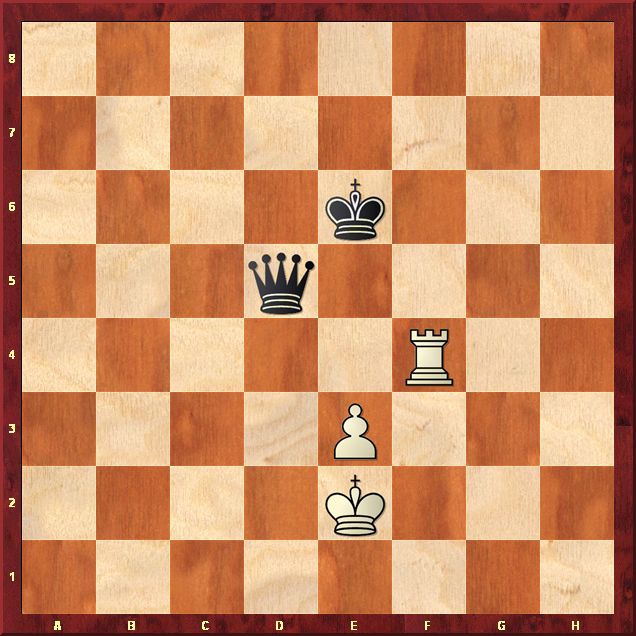
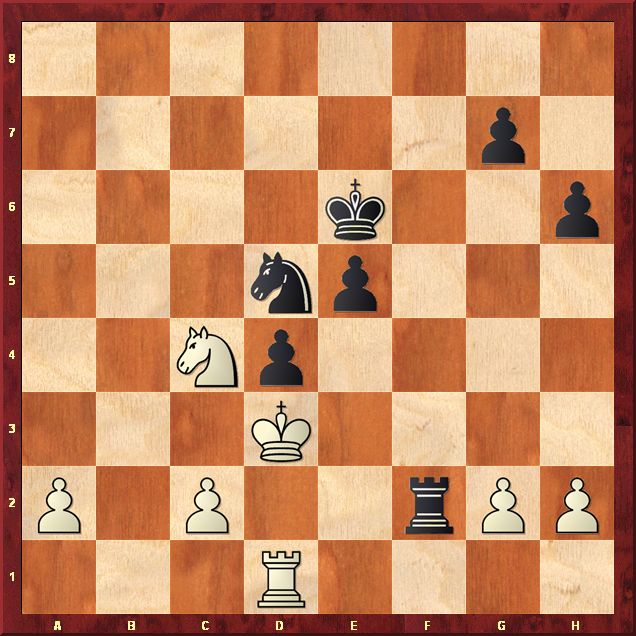
It was the most amazing move of the 2011 Chess World Cup in Khanty Mansiysk, Russia, a wonderful coup de grâce you don't see every day. And it could have been enough to play it, go home and enjoy it for years to come. But it was not all Peter Svidler had done at the World Cup this month. The six-time champion of Russia easily carved through the 128-player knockout tournament and won it almost as efficiently and convincingly as Novak Djokovic did the tennis Grand Slams at Wimbledon, Melbourne and New York this year. It was Svidler's greatest result.
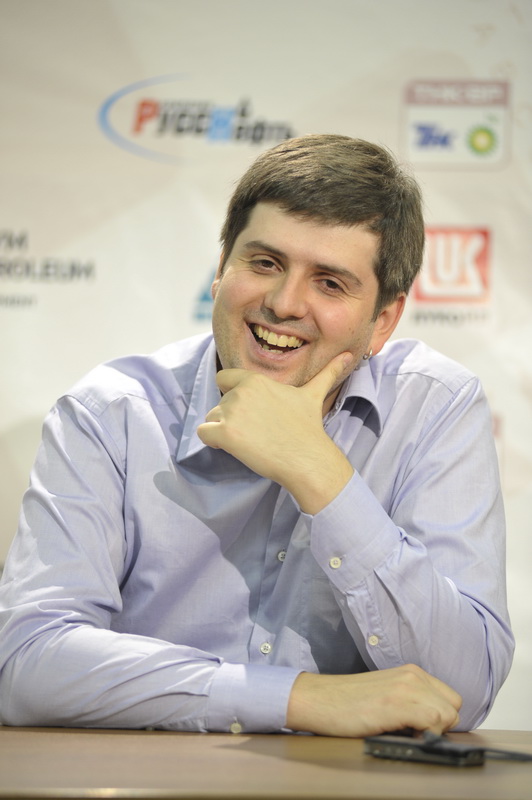
Svidler defeated his countryman Alexander Grischuk 2.5-1.5 in the final match.Vassily Ivanchuk of Ukraine finished third, eliminating his countryman Ruslan Ponomariov 2.5-1.5 in the match for the bronze medal. The top three players qualified for the next Candidates, a final 8-player event to determine the challenger for the world crown after 2012.
Svidler's Magic
Sliding his rook towards Gata Kamsky's pieces, Svidler sensed that his astonishing move didn't belong to 21st century. In the computer age such a brilliant move is not usually allowed. It belonged to the games of Adolf Anderssen, the great German attacker who in the 1850s created both, the Immortal and the Evergreen games; or to the Belgian doctor who played chess with Humphrey Bogart.
Kamsky had to win the game and played the Spanish Opening cleverly. Svidler was outplayed. The U.S. champion not only won a pawn, but his pieces were swarming around the black king. But as it often happens in chess, out of desperation beautiful ideas are born. Svidler launched a counterattack that was gaining strength and suddenly Kamsky could not handle the storm. The surprising rook move was a "blow of mercy."
1.e4 e5 2.Nf3 Nc6 3.Bb5 a6 4.Ba4 Nf6 5.0-0 b5 6.Bb3 Bc5 7.a4 Rb8 8.axb5 axb5 9.c3 d6 10.d4 Bb6 11.Be3 0-0 12.Nbd2 h6 13.h3 Re8 14.Qc2 (Svidler calls it a poisonous little move. 14.Re1 is the most popular choice.) 14...exd4 (After 14...Bb7 the connection between the rook on b8 and black's dark bishop is broken and white can proceed with 15.d5 Bxe3? 16.dxc6 Bxd2 17.cxb7. Not only doesn't white rook stand on e1, but the dark bishop is in trouble.) 15.cxd4 Na5 (One can alwyas talk about the Tarrasch dictum about a badly placed knight on the edge. Instead, black could have finished the development, bringing the bishop into play: 15...Bb7 and because the square b4 is free, the pawn advance is not dangerous anymore: 16.d5 Nb4 17.Qc3 Bxe3 18.fxe3 Na6 19.Bc2 Nc5 and black has no problems.) 16.Ba2 Bb7 17.e5 (After 17.d5 Bxe3 18.fxe3 c6 black holds quite comfortably, for example 19.b4 Nc4 20.dxc6 Bxc6 21.Nxc4 Bxe4.) 17...Nd5 ("Normally this set up is very much in black's favor," Svidler explained. "I just assumed I play next Nd5-b4 and take the bishop. He played Bb1 and I'm very lucky I'm not just losing immediately.") 18.Bb1 g6 19.Bxh6 Nc6 ("I'm not saying I'm fine but it's trickier than it looks." - Svidler)
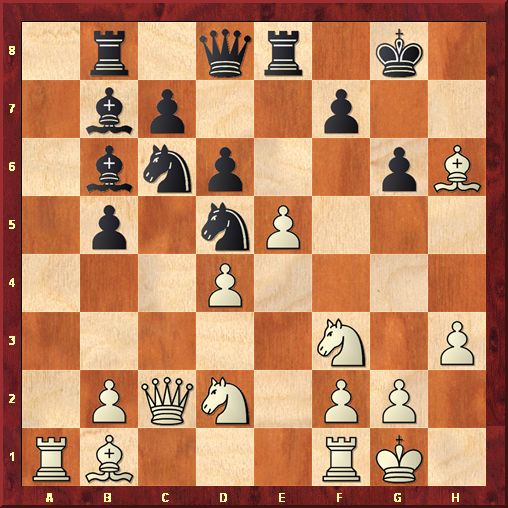
20.exd6 ("It seems that this is the move that throws away white's advantage," Svidler thought. Moving the white queen to the center was suggested by many experts, but it is not clear how white could have a big advantage after that. For example:
A. 20.Qe4 dxe5!? 21.dxe5 Nf6 [21...f5 22.Qe2 Nxe5 23.Nxe5 Qh4 24.Qxb5 Qxh6 25.Ndf3 with white's edge.] 22.Qh4!? Nxe5 23.Bg5 Ned7 [After 23...Nxf3+? 24.Nxf3 white wins either after 24...Kg7 25.Qh6+ Kg8 26.Bxg6; or after 24...Bxf3 25.Bxf6 Bxf2+ 26.Qxf2 Qxf6 27.Ra3!] 24.Bd3 Bc6 25.Rae1 with white's advantage.
A. 20.Qe4 dxe5!? 21.dxe5 Nf6 [21...f5 22.Qe2 Nxe5 23.Nxe5 Qh4 24.Qxb5 Qxh6 25.Ndf3 with white's edge.] 22.Qh4!? Nxe5 23.Bg5 Ned7 [After 23...Nxf3+? 24.Nxf3 white wins either after 24...Kg7 25.Qh6+ Kg8 26.Bxg6; or after 24...Bxf3 25.Bxf6 Bxf2+ 26.Qxf2 Qxf6 27.Ra3!] 24.Bd3 Bc6 25.Rae1 with white's advantage.
B. After 20.Qe4 Kamsky looked at 20...Nxd4!? 21.Nxd4 [21.Bg5 is met by 21...Nf4!] 21...Rxe5, but after 22.Qg4 white's position is more pleasant either after 22...Nf6 23.Qg3!? Bxd4 24.Bxg6 Kh8 25.Bxf7 Nh5 26.Qg4 Qf6 27.Qxd4 c5 28.Qg4 Qxh6 29.Nf3; or after 22...Rh5 23.Bxg6 Rxh6 24.Be4+ Kf8 25.Nf5 Rg6 26.Qf3 c6 27.Nb3.)
20...Qxd6 21.Ne4 Qb4 22.Ba2 (Svidler thought first that he was lost, but it dawned on him that something spectacular is about to happen. After 22.Bd2 Nxd4 23.Bxb4 Nxc2 24.Bxc2 Nxb4 25.Nf6+ Kh8 26.Nxe8 Nxc2 27.Rac1 Bxf3 28.Rxc2 [ 28.gxf3 Nd4] 28...Be4 29.Rxc7 Rxe8 30.Rxf7 black is fine with the bishop pair.) 22...Nxd4 23.Nf6+ Kh8 24.Nxd4 (Kamsky had to win and 24.Nxd5 is petering out to a draw after 24...Nxc2 25.Nxb4 Nxb4 26.Bxf7 Re2 or after 24...Nxf3+ 25.gxf3 Bxd5 26.Bxd5 Qh4, threatening 27...Qg3+ with perpetual check and after 27.Be3 Bxe3 28.fxe3 Qg5+ 29.Kh2 Qxd5 the chances are equal.) 24...Nxf6 25.Nc6
(Svidler's first reaction was that he had to capture the knight, but then he found something else.)25...Qh4! ("Here I'm probably already better but it isn't obvious immediately. After 25...Bxc6 26.Qxc6 Qh4 white has this horribly strong move 27.Be3. I realized black is in a huge amount of trouble because my pieces are not coordinated. As soon as this bishop is exchanged away, all my potential initiative is gone: pawn on f7 is hanging, pawn on c7 will be hanging. I think I'm close to lost here. So I started looking at some romantic variations starting with Qh4." - Svidler) 26.Nxb8? (Allowing a magnificent clincher. "There really isn't much white can do here. After 26.Be3 Rxe3 27.fxe3 Re8 for a single exchange I'm getting this horrible attack on the kingside and there really isn't much he can do. I definitely have a draw everywhere here and probably I'm already even winning. " - Svidler;
Perhaps the best way for white to resist is 26.Bxf7 Qxh6 27.Bxe8 Rxe8 28.Rae1.)
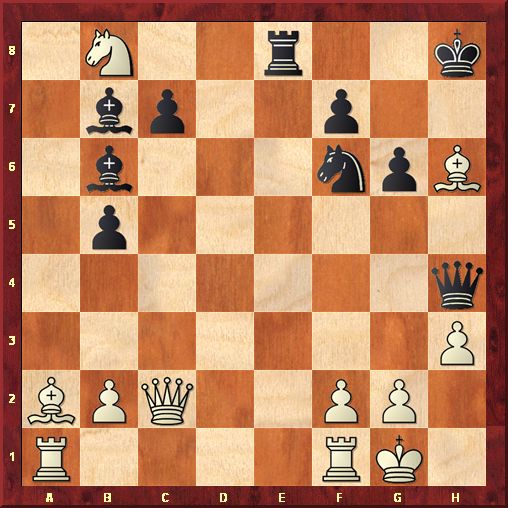
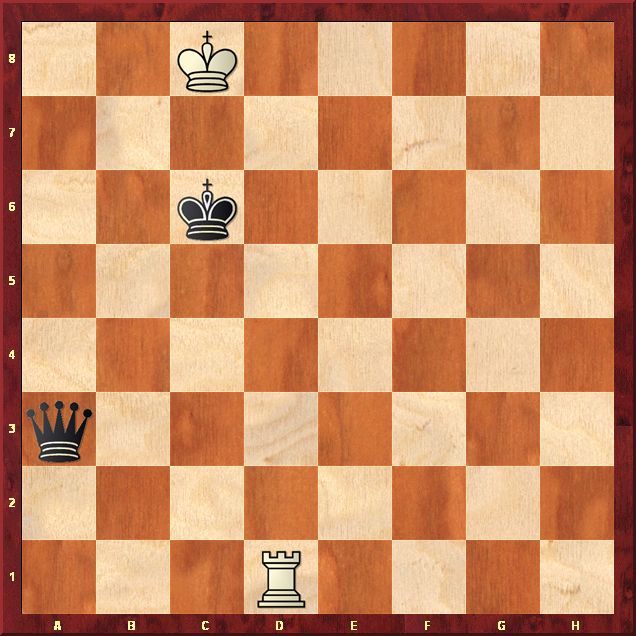
(Svidler's coup de grâce: "It's something you see in Anderssen's games. Put on the cover of a book. Suddenly white is just completely lost."
Before arriving at this amazing deflection, Svidler considered two other continuations:
A. 26...Be4 was Svidler's initial idea, but after 27.Qd2 Qg3 [After 27...Ng4 28.Bf4 the whole thing collapses because black is running out of pieces.] 28.Qg5 black's attack is refuted.
B. 26...Qg3 27.Nc6 Re2 was Svidler's other idea, which can be met by 28.Qc3 Bxf2+ 29.Kh1 Qxc3 30.bxc3 Bxc6 31.Rfd1 with roughly equal chances.
"But why am I starting this with 26...Qg3? This is where it dawned on me what was happening," Svidler explained his thinking process. )
27.Qc3 (After 27.Qxe2 Qg3 nothing stands in the way of black's light bishop; the diagonal a8-h1 can't be blocked and white is being mated on g2.) 27...Rxf2 28.Nc6 Rxf1+ ("...and I'm just collecting the entire chess set. It's a very nice feeling to make a move like Re2 on the board. It really doesn't happen every day. It's a great feeling. It's something you don't really see in the modern game because you never have an opportunity to do anything like that." - Svidler) White resigned.
27.Qc3 (After 27.Qxe2 Qg3 nothing stands in the way of black's light bishop; the diagonal a8-h1 can't be blocked and white is being mated on g2.) 27...Rxf2 28.Nc6 Rxf1+ ("...and I'm just collecting the entire chess set. It's a very nice feeling to make a move like Re2 on the board. It really doesn't happen every day. It's a great feeling. It's something you don't really see in the modern game because you never have an opportunity to do anything like that." - Svidler) White resigned.
The Belgian doctor
During a team competition in Brussels in 1970 I met an older man who introduced himself as dr. Limbos. He put me quickly at ease, saying: "I love chess, but I do not have much time to play." I had not heard of him before and had not the slightest idea that it was the same dr. Paul Limbos who played chess with Humphrey Bogart during the filming of "The African Queen" in 1951.
Bogart did not know that Limbos was a strong player, strong enough to win the city championship of Brussels several times and the Belgian championship as well. Yet Limbos had a habit of making his opponents believe that he was just an amateur. Bogart agreed to play for a dollar a game with the Belgian doctor, but must have regretted soon his decision. Limbos was smashing him game after game even though Katharine Hepburn and Lauren Bacall kept helpfully filling Limbos's glass with whiskey in the hope to level the competition.
I didn't even know that dr. Limbos played for Belgium at the chess olympiads and when I had a chance to begin a reckless attack in Misha Tal's style, I jumped at the opportunity. The attacking material, a pair of bishops and the queen, was similar to Svidler's weapons. Soon I realized that my opponent, who acted like an amateur and spoke like an amateur was not playing like an amateur. He smashed my attack with an incredibly brilliant queen move, a game clincher one may produce once in a lifetime.
1.e4 c5 2.Nf3 d6 3.d4 cxd4 4.Nxd4 Nf6 5.f3 Nc6 6.c4 e6 7.Nc3 Be7 8.Nc2 0-0 9.Be2 b6 10.0-0 Bb7 11.b3 Re8 12.Qd2
(White has an interesting plan in mind. He wants to play Rf1-d1 and Bc1-a3, but the queen move allows the central break d6-d5 black is aiming for. It could have been prevented with 12.Ne3.)
12...d5! 13.cxd5 exd5 14.Nxd5 Nxd5 15.exd5 Ne5 (I could have equalized immediately with 15...Nb4 16.Nxb4 Bxb4 17.Qxb4 Rxe2, but I tried to keep more pieces on the board.)
16.Rd1 (After 16.Bb5 Bc5+ 17.Kh1 Re7 the game is roughly equal.) 16...Bc5+ 17.Kh1 Qh4 18.Bb5 Bxd5!? (I should have been punished for this reckless move. It was sufficient to play 18...Red8 with a good game, but I couldn't resist the following attacking ideas with pieces flying around and hanging at the same time.)
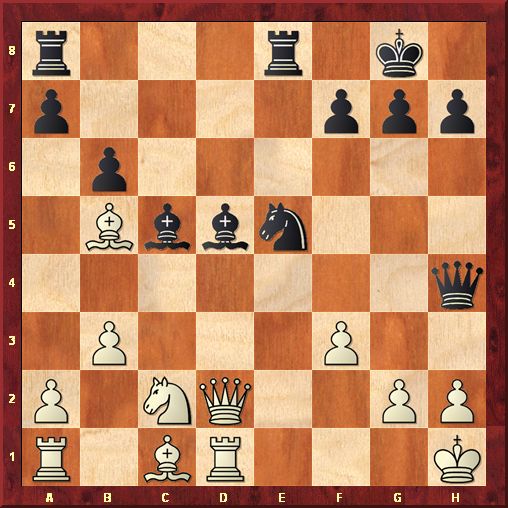
19.Bxe8! (Dr. Limbos is on the right path. Taking the rook is stronger than 19.Qxd5 Rad8 20.Bb2 Rxd5 21.Rxd5 Nxf3 22.gxf3 Rc8 23.Rf1.) 19...Ng4! (Threatening mate on h2 and, at the same time, opening the diagonal h2-b8. 19...Nxf3 allows 20.Qf4.)
20.Bxf7+! (The doctor finds another strong move. Black's main idea is 20.fxg4 Bd6 and as in Svidler's game, black seems to have a raging attack with a bishop pair and the queen.)
20...Kh8! (One may argue that 20...Kf8 is better, forcing a king's chase 21.fxg4 Bd6 22.Kg1 Qxh2+ 23.Kf1 [On 23.Kf2? Qxg2+ 24.Ke3 Qf3+ 25.Kd4 Bc5+ 26.Ke5 Qe4 mates.] 23...Qh1+ 24.Ke2 Qxg2+ 25.Kd3 Qe4+ 26.Kc3 Be5+ 27.Nd4 Bxf7 but now 28.Qf2 pins the bishop on f7 and white has time to protect the knight with 29.Be3.
Other moves lose: 20...Bxf7 21.fxg4 wins.; 20...Kxf7 21.Qxd5+ wins.)
21.fxg4 Bd6
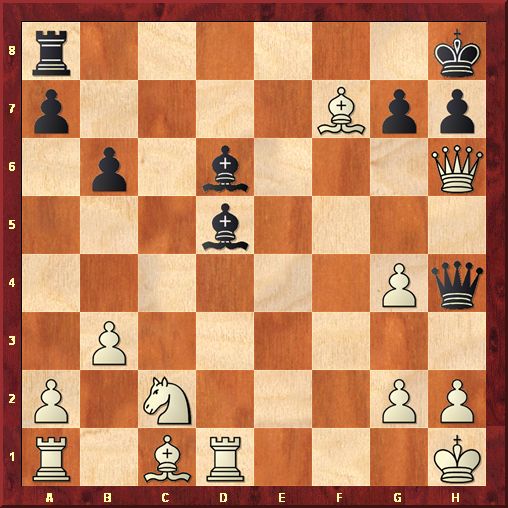
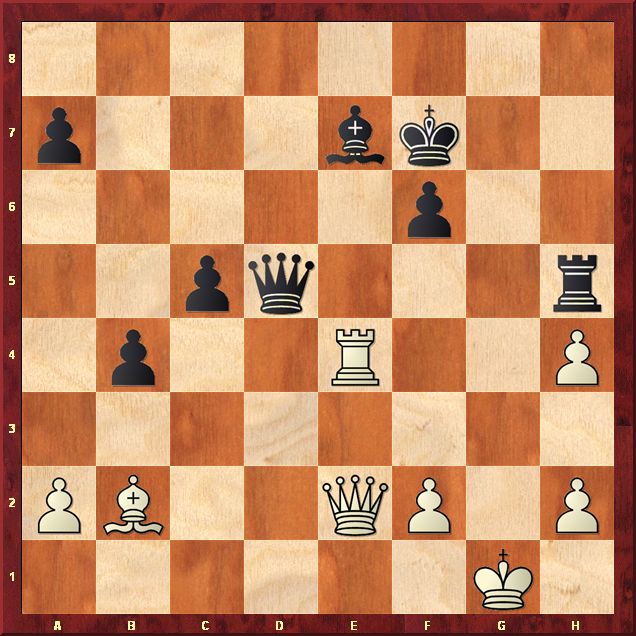
(A coup de grâce! I overlooked this magnificent move that should have won the game. Instead, I thought I could hunt the white king and my chances didn't seem bad at all. Incredibly, running away with the king gives black a lot of play: 22.Kg1 Qxh2+ 23.Kf1 Qh1+ 24.Ke2 [24.Kf2? Qxg2+ 25.Ke3 Qf3+ 26.Kd4 Bc5+ 27.Ke5 Qe4 mate.] 24...Qxg2+ 25.Kd3 Qe4+ 26.Kc3 Be5+ 27.Nd4 Bxf7 with some attacking chances, for example 28.Qd3 [After 28.Qf2 Rc8+ 29.Kb2 Bg6 threatening 30...Rc2+, white has problems.] 28...Rc8+ 29.Kb2 Qg2+! 30.Ka3 (Black is better after either 30.Bd2 Rd8; or 30.Rd2 Qxg4.] 30...Bd6+ 31.b4 a5! 32.Rd2 Rc3+! 33.Qxc3?! axb4+ 34.Qxb4 Qa8+ wins.) 22...Bxg2+ (The only way to continue. After 22...gxh6?? 23.Bb2+ white mates soon.) 23.Kxg2 Qxg4+ 24.Kf2 Qf5+ (24...Bc5+ as later in the game, is better.) 25.Kg2?! (White should have taken advantage of my last move with 25.Ke2! gxh6 26.Bb2+ Be5 27.Ne3 Qf4 28.Rf1 Qxh2+ 29.Rf2 Qg3 30.Rg1 and white wins.) 25...Qg4+ 26.Kf2 Bc5+ 27.Ne3 Rf8(The desire to bring the last piece into play backfires. But collecting material does not help either: 27...Qxd1 28.Qh5 [28.Qxg7+ does not work: 28...Kxg7 29.Bb2+ Qd4!] 28...Bxe3+ 29.Kxe3 Qe1+ 30.Kd3! Rd8+ 31.Bd5 Qa5 32.Kc2 Qc5+ 33.Kb1 white wins.)
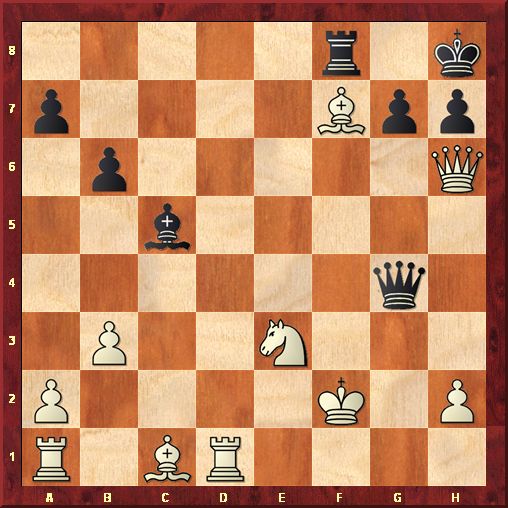
(Blundering the game away. White could have won with 28.Ke1!, for example
a) 28...Bb4+ 29.Bd2 Qd4 30.Qe6 Bxd2+ 31.Ke2+-;
b) 28...Qf3 29.Qh4 Qxf7 (29...Bxe3 30.Qg3+-) 30.Rd8;
c) 28...Qg1+ 29.Ke2.)
28...Rxf7+ 29.Ke1 Qh4+ 30.Ke2 (After 30.Kd2 Rf2+ 31.Kc3 Qb4+ 32.Kd3 Qd4 mates.) 30...Rf2+ 31.Ke1 (Or 31.Kd3 Qd4 mate.) 31...Rxh2+ (After 32.Kf1 Qf2 mates.) White resigned.
a) 28...Bb4+ 29.Bd2 Qd4 30.Qe6 Bxd2+ 31.Ke2+-;
b) 28...Qf3 29.Qh4 Qxf7 (29...Bxe3 30.Qg3+-) 30.Rd8;
c) 28...Qg1+ 29.Ke2.)
28...Rxf7+ 29.Ke1 Qh4+ 30.Ke2 (After 30.Kd2 Rf2+ 31.Kc3 Qb4+ 32.Kd3 Qd4 mates.) 30...Rf2+ 31.Ke1 (Or 31.Kd3 Qd4 mate.) 31...Rxh2+ (After 32.Kf1 Qf2 mates.) White resigned.
Anderssen's Evergreen masterpiece
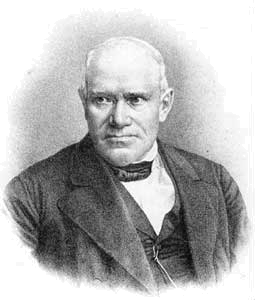
The German master Adolf Anderssen (1818-1879) was the world's leading player in the mid-19th- century. His attacks and combinations were remarkable and memorable. His friendly game against Lionel Adalbert Bagration Felix Kieseritzky in London in 1851 was called the "Immortal game." One year later in Berlin, he created the "Evergreen game" against Jean Dufresne. Svidler might had the former game in mind when he referred to Anderssen. The German maestro seems to be on the ropes when suddenly his white rook delivers the final blow on the same square as Svidler did with his black rook. Technically, the coup de grâce is the queen sacrifice on the next move.
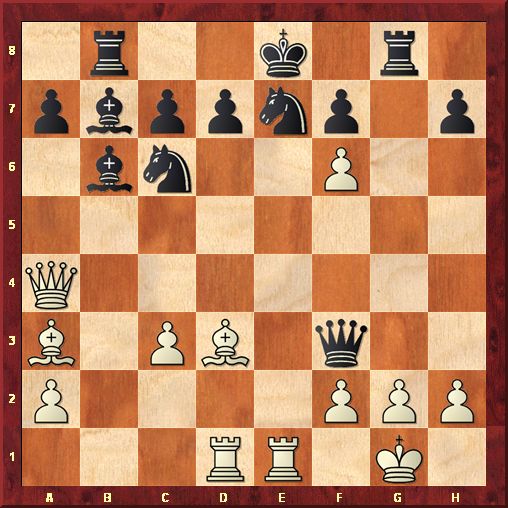
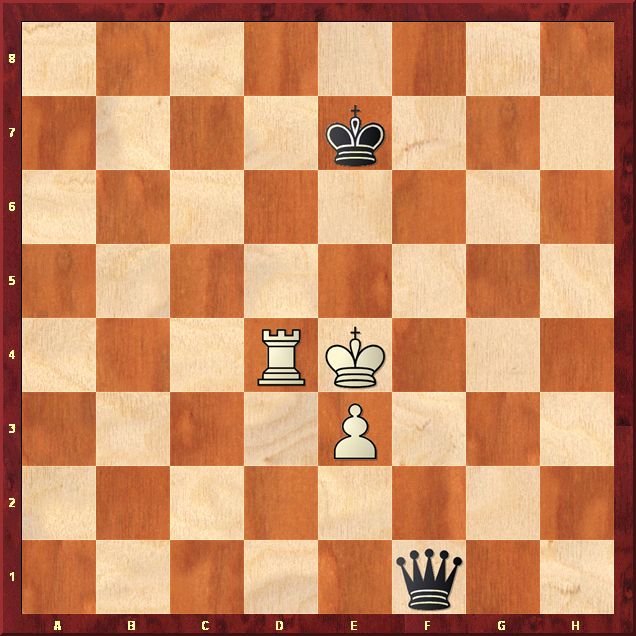
20.Rxe7+! Nxe7!? (After 20...Kd8 21.Rxd7+! Kc8 (21...Kxd7 22.Bf5+ Ke8 23.Bd7+ Kd8 24.Bxc6+ with mate; 21...Ke8 22.Re7+ Kd8 23.Be2+ Bd4 24.Bxf3 and white mates soon.) 22.Rd8+! Kxd8 (22...Rxd8 23.gxf3 wins; or; 22...Nxd8 23.Qd7+!! Kxd7 24.Bf5+ Kc6 25.Bd7#) 23.Be2+ Nd4 24.Bxf3 Bxf3 25.g3 Bxd1 26.Qxd1 and white should win the endgame.] 21.Qxd7+!! (Coup de grâce.) 21...Kxd7 22.Bf5+ Ke8 23.Bd7+ Kf8 24.Bxe7 mate.